Incompletely Specified Functions
-
Incompletely
specified function:
-
Output
value is not known for every combination of input variables because all
combinations cannot occur.
-
Truth
table does not generate an output value for every possible combination of input
values.
-
Min-terms
or max-terms that are not used as part of the output function are called don’t care terms.
Examples
Conversion of BCD to Ex-3
|
Binary |
Ex-3 |
||||||
|
W |
X |
Y |
Z |
A |
B |
C |
D |
|
|
|
|
|
|
|
|
|
|
0 |
0 |
0 |
0 |
0 |
0 |
1 |
1 |
|
0 |
0 |
0 |
1 |
0 |
1 |
0 |
0 |
|
0 |
0 |
1 |
0 |
0 |
1 |
0 |
1 |
|
… |
… |
… |
… |
… |
… |
… |
… |
|
1 |
0 |
0 |
1 |
1 |
1 |
0 |
0 |
|
1 |
0 |
1 |
0 |
Don’t care |
|||
|
1 |
0 |
1 |
1 |
Don’t care |
|||
|
… |
… |
… |
… |
… |
… |
… |
… |
|
1 |
1 |
1 |
1 |
Don’t care |
|||
A =
f(w,x,y,z) = Σ(5,6,7,8,9) + Σ d(10,11,12,13,14,15)
B =
f(w,x,y,z) = Σ(1,2,3,4,9) + Σ d(10,11,12,13,14,15)
C =
f(w,x,y,z) = Σ(0,3,4,7,8) + Σ d(10,11,12,13,14,15)
D =
f(w,x,y,z) = Σ(0,2,4,6,8) + Σ d(10,11,12,13,14,15)
-
Don’t
care terms can be assigned a value 0 or 1.
Rule for simplification with K-Map
If
don’t care terms help in creating a larger group of min-terms, then we can
assign it as a 1. If it does not help in creating a larger group, then we
assign it as a 0.
Example
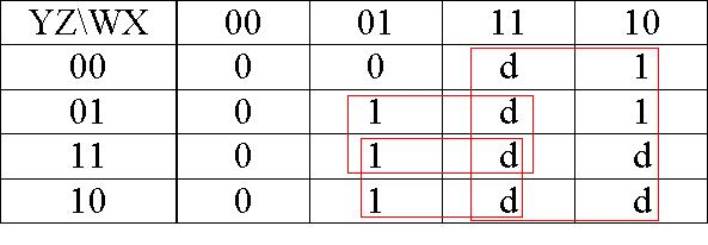
A =
W + XZ + XY
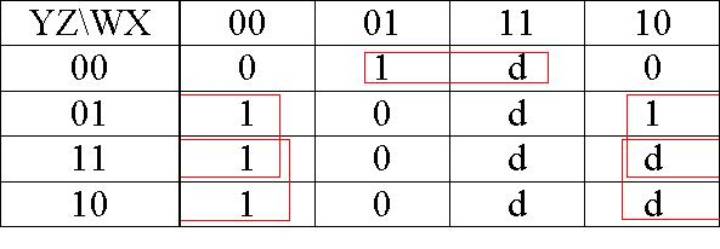
B =
X’Z + X’Y + XY’Z’
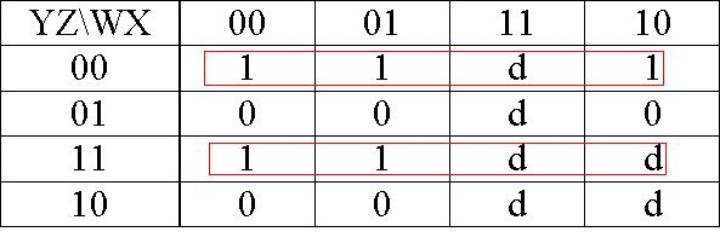
C =
Y’Z’ + YZ
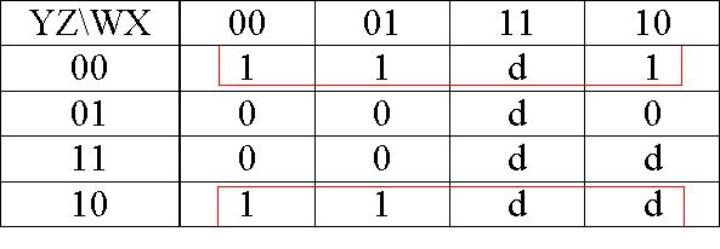
D =
Z’
A =
(W’ * (XZ)’ * (XY)’)’
B =
((X’Z)’ * (X’Y)’ * (XY’Z’)’)’
C =
((YZ)’ * (Y’Z’)’)’
D =
Z’